

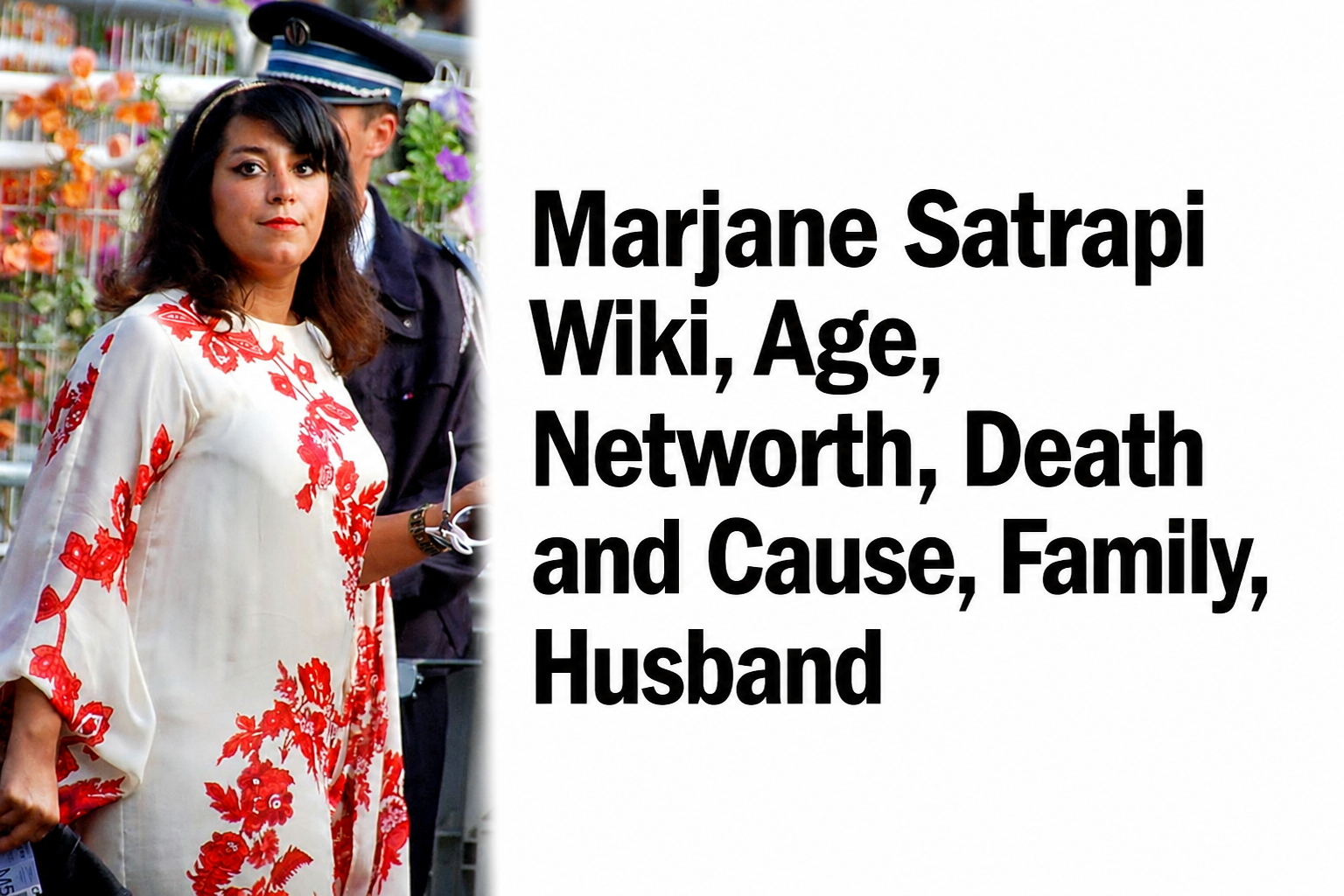
If you have recently read Persepolis, watched its Oscar-nominated animated adaptation, or followed breaking news on June 4, 2026, you are likely searching for more about Marjane Satrapi — the acclaimed French-Iranian graphic novelist, filmmaker, and human rights icon who passed away today at the age of 56. From her extraordinary childhood in post-revolutionary Iran to her landmark creative works and the heartbreaking story of her final months, this comprehensive guide covers everything about Marjane Satrapi’s life, death, family, and enduring legacy in one place.
Who Was Marjane Satrapi?
Marjane Satrapi was a French-Iranian graphic novelist, author, illustrator, filmmaker, and human rights activist — and one of the most influential creative voices of the 21st century. She is best known for Persepolis, her groundbreaking autobiographical graphic novel series (2000–2003) that transformed her childhood experience of Iran’s Islamic Revolution into one of the world’s most celebrated works of sequential art. The book has been translated into dozens of languages, sold millions of copies worldwide, and inspired a generation of artists, writers, and activists.
Beyond the page, Satrapi was a tireless critic of Iran’s theocratic government and a vocal champion of democracy, freedom of expression, and women’s rights. Her voice resonated far beyond the literary world — she was a presence at global forums, a media personality, and a living bridge between Iran and the West.
“Her passing marks the loss of a leading figure in French culture and a freedom-loving artist whose work carried a universal message and earned her immense international acclaim.”
— French President Emmanuel Macron, June 4, 2026
Wiki/Biography
| Full Name | Marjane Satrapi |
| Born | 22 Nov 1969 Rasht, Iran |
| Died | 4 June 2026 Paris, France |
| Age at Death | 56 years |
| Cause | “Died of sadness” (grief after husband’s death) |
| Nationality | French-Iranian |
| Ethnicity | Iranian (Persian) |
| Known For | Persepolis Graphic Novel & Film |
| Occupation | Author, Illustrator, Filmmaker, Activist |
| Education | Lycée Français Tehran; Arts Déco Strasbourg |
| First Marriage | Reza (Tehran, early 1990s) |
| Husband | Mattias Ripa (d. April 8, 2025) |
| Children | None |
| Languages | Persian, French, English |
| Cannes Award | Jury Prize 2007 |
| Oscar | Nominated — Best Animated Feature (2008) |
| Other Awards | Princess of Asturias (2024) |
| Foundation | Mattias & Marjane Ripa-Satrapi Cinema Foundation |
| French Academy | Member, Fine Arts |
| Last Work | Woman, Life, Freedom (2024) |
| Category | Biography |
Age, Death & Cause of Death
Marjane Satrapi was born on November 22, 1969, in Rasht, Iran. She was 56 years old at the time of her death.
Marjane Satrapi died on June 4, 2026, in Paris, France. In a deeply poignant statement released to the AFP news agency, her family announced: “Marjane Satrapi died of sadness a little over a year after the death of Mattias Ripa, her husband and the love of her life.”
Her husband, Swedish producer, actor and screenwriter Mattias Ripa, had died on April 8, 2025. In the months following his passing, Satrapi had quietly posted a series of messages on her Instagram page that collectively formed the sentence: “For I lost the love of my life.” The loss had devastated the artist, and she never recovered from the grief.
Date of Death: June 4, 2026
Place of Death: Paris, France
Age at Death: 56 years old
Cause of Death: “Died of sadness” (family statement to AFP) — following the death of her husband Mattias Ripa on April 8, 2025
Announcement Source: Statement to Agence France-Presse (AFP).
Biography – Early Life & Background
Marjane Satrapi was born on November 22, 1969, in Rasht, a city in northwestern Iran. Shortly after her birth, her family relocated to Tehran, the Iranian capital, where she grew up and attended the prestigious Lycée Français (French school). She was an only child, raised in an educated, secular, upper-middle-class household.
Her parents — her father an engineer, her mother a clothing designer — were politically active leftists who opposed the monarchy of Shah Reza Pahlavi and later became vocal critics of the Islamic Republic that followed the 1979 revolution. This environment of political consciousness shaped Marjane’s worldview from an early age.
Growing Up Through Revolution
Satrapi was just 10 years old when Ayatollah Khomeini came to power following the 1979 Iranian Revolution. What had begun as a promising social uprising quickly became a repressive theocracy. Mandatory veiling, censorship of Western music and culture, and the brutal Iran–Iraq War (1980–1988) defined her formative teenage years. Her family watched as friends and relatives were arrested and persecuted.
Despite the restrictions around her, Satrapi was a rebellious young girl — secretly listening to Iron Maiden, wearing a Michael Jackson button, and accessing forbidden Western books through her family’s extensive home library. These small acts of defiance would later become memorable scenes in Persepolis.
Move to Europe
Fearing for their daughter’s safety under the increasingly oppressive regime, Satrapi’s parents made the painful decision to send her to Vienna, Austria at the age of 14 in 1983. She attended school there and lived with family friends. The experience of being a displaced young Iranian in Europe — culturally uprooted, neither fully Western nor permitted to be fully Iranian — became the second major act of her autobiography.
She later returned to Tehran to pursue her studies, enrolling at the School of Fine Arts — though she ultimately departed Iran for good in 1994, moving to France. She studied at the School of Decorative Arts in Strasbourg and later settled permanently in Paris. She obtained French nationality in 2006.
Education
- Lycée Français, Tehran — primary and secondary education in Iran
- Vienna, Austria (1983) — completed schooling at a French-language lyceum
- School of Fine Arts (L’École de Beaux-Arts), Tehran — began a degree in visual communication
- School of Decorative Arts (Arts Déco), Strasbourg, France — completed studies after emigrating in 1994
Career & Literary Works
After settling in Paris in the late 1990s, Satrapi began creating black-and-white comic strips recounting her experience growing up in Tehran. The result was Persepolis — first published in France in 2000 — a visceral, witty, and deeply personal narrative of girlhood during the Islamic Revolution and its aftermath.
Persepolis — A Global Phenomenon
Persepolis was immediately acclaimed as a masterwork of graphic literature. The book, drawn in stark black and white, recounts Satrapi’s life from age six to fourteen — encompassing the fall of the Shah, the Islamic Revolution, the Iran–Iraq War, and her departure for Europe. Its humanity, humour, and political clarity made it unlike any graphic novel published before.
The series was followed by Persepolis 2 (2002) and two standalone graphic novels — Embroideries (2003) and Chicken with Plums (2004). The works resonated especially with women around the world, who saw in Satrapi’s coming-of-age story their own contemplations of selfhood, freedom, and belonging.
Major Published Works
| Title | Year | Type | Notes |
|---|---|---|---|
| Persepolis (Vol. 1 & 2) | 2000–2002 | Graphic Novel | Autobiographical; millions of copies sold worldwide |
| Embroideries (Broderies) | 2003 | Graphic Novel | Iranian women’s stories; acclaimed internationally |
| Chicken with Plums (Poulet aux prunes) | 2004 | Graphic Novel | Adapted into a film (2011) |
| Monsters Are Afraid of the Moon | 2004 | Children’s Book | Written for younger audiences |
| Woman, Life, Freedom | 2024 | Graphic Novel (Collaborative) | Documents Mahsa Amini protests; free online for Iranians |
Film Career
In 2007, Satrapi co-directed an animated adaptation of Persepolis with French director Vincent Paronnaud. The film debuted at the Cannes Film Festival, where it shared the prestigious Jury Prize. It was then selected as the French entry for Best International Feature at the 80th Academy Awards and received a nomination for Best Animated Feature — making Satrapi the first woman ever nominated in that category.
Her subsequent films included Chicken with Plums (2011, Venice premiere), the comedy-horror The Voices (2014, starring Ryan Reynolds), and Radioactive (2019/2020), a biopic of Nobel Prize laureate Marie Curie starring Rosamund Pike.
Life Timeline
- 1969Born November 22 in Rasht, Iran. Family soon moves to Tehran.
- 1979Age 10 when the Iranian Revolution brings Ayatollah Khomeini to power. Her childhood is upended.
- 1983Parents send her to Vienna, Austria at age 14 to escape the Islamic Republic’s restrictions.
- 1988Returns to Tehran; enrols in the School of Fine Arts to study visual communication.
- 1994Emigrates permanently to France; studies at Strasbourg’s School of Decorative Arts. Settles in Paris.
- 2000Persepolis Vol. 1 published in France to immediate critical acclaim.
- 2006Obtains French nationality.
- 2007Persepolis animated film premieres at Cannes — wins Jury Prize; Oscar nomination for Best Animated Feature (first woman nominated in this category).
- 2011Chicken with Plums premieres at Venice Film Festival.
- 2014Directs The Voices starring Ryan Reynolds.
- 2020Radioactive (Marie Curie biopic, starring Rosamund Pike) released.
- 2022Vocally supports Mahsa Amini protests and Women, Life, Freedom movement in Iran.
- 2024Awarded the Princess of Asturias Award for Communication and Humanities. Publishes Woman, Life, Freedom. Refuses the French Légion d’Honneur.
- Apr 2025Husband Mattias Ripa dies at age 53. Satrapi is devastated by the loss.
- Jun 2026Marjane Satrapi dies in Paris on June 4, aged 56. Family states she “died of sadness.”
Family
Parents
Satrapi was born to secular, Marxist parents who were politically active against the monarchy of Shah Reza Pahlavi and later opposed the Islamic Republic. Her father was an engineer and her mother a clothing designer. Both parents were central figures in Persepolis, depicted as progressive, loving, and intellectually engaged people who ultimately encouraged their daughter to build a life outside Iran for her own safety. Their names have not been prominently publicised.
First Marriage – Reza
Before settling in France permanently, Satrapi was briefly married to a man named Reza during her early adulthood in Tehran. The two met at an underground gathering after her return from Austria. The marriage did not last, and Satrapi later emigrated to Europe alone.
Husband – Mattias Ripa (died April 8, 2025)
Satrapi’s great love was Mattias Ripa, a Swedish producer, actor, screenwriter, and translator. The two lived together in Paris and shared a deep partnership both personally and professionally. Ripa was known as the producer of films including Dear Paris and La bande des Jotas. He died on April 8, 2025, at the age of 53. Following his death, Satrapi set up the Mattias and Marjane Ripa-Satrapi Cinema Foundation to support foreign students wishing to study filmmaking in Paris — a final act of devotion to their shared love of cinema.
“Marjane Satrapi died of sadness a little over a year after the death of Mattias Ripa, her husband and the love of her life.”
— Statement from close friends and family to AFP, June 4, 2026
Children
Marjane Satrapi did not have children. She was a private person about her personal life, though her art was deeply autobiographical and intimate in its portrayal of family, identity, and love.
Awards & Recognition
- Cannes Film Festival Jury Prize (2007) — for Persepolis (shared with Silent Light)
- Academy Award Nomination – Best Animated Feature (2008) — first woman ever nominated in this category
- Annie Award Nomination (2008) — for Persepolis
- Member of the French Academy of Fine Arts
- Princess of Asturias Award for Communication and Humanities (2024) — among Spain’s most prestigious cultural prizes
- Refused the French Légion d’Honneur (2025) — a principled political gesture consistent with her values
- Named one of the most important graphic novelists in the world by multiple international publications
Activism & Legacy
Throughout her life, Satrapi was an unwavering critic of Iran’s theocratic government and a passionate advocate for democracy, women’s rights, and freedom of expression. She lent her voice and pen to the Women, Life, Freedom movement following the murder of Mahsa Amini by Iran’s “morality police” in 2022, describing it as “a cultural revolution.” Her 2024 collaborative graphic novel Woman, Life, Freedom — made freely available online in Persian for Iranian readers — became her final major work.
The French Academy of Fine Arts, of which she was a member, described her as “a passionate advocate for cinema and film education.” In her final year of life, she created the Mattias and Marjane Ripa-Satrapi Cinema Foundation to help international students study filmmaking in Paris.
Latest News – June 2026
- Death Announced (June 4, 2026): Satrapi’s family confirmed her death in Paris to AFP with the statement that she had “died of sadness” following the death of her husband Mattias Ripa in April 2025.
- Emmanuel Macron Tribute: French President Emmanuel Macron’s office issued a statement calling her “a leading figure in French culture and a freedom-loving artist whose work carried a universal message.”
- French Academy of Fine Arts: Expressed “deep sadness” on social media, paying tribute to her as “a passionate advocate for cinema and film education.”
- Global Outpouring: Tributes poured in from writers, filmmakers, human rights organisations, and fans across the world — from Tehran to Paris to New York.
- Cinema Foundation: Earlier in 2026, Satrapi had created the Mattias and Marjane Ripa-Satrapi Cinema Foundation to provide support for foreign students who want to study filmmaking in Paris — a legacy institution that will carry their story forward.
Frequently Asked Questions
When did Marjane Satrapi die?
Marjane Satrapi died on June 4, 2026, in Paris, France, at the age of 56. Her family announced her death in a statement to AFP.
What was Marjane Satrapi’s cause of death?
According to her family’s statement to AFP, Marjane Satrapi “died of sadness” — a profound grief following the death of her husband and the love of her life, Mattias Ripa, who passed away on April 8, 2025. No further medical details were disclosed by the family.
How old was Marjane Satrapi when she died?
Marjane Satrapi was 56 years old when she died. She was born on November 22, 1969, in Rasht, Iran.
What is Persepolis about?
Persepolis is Marjane Satrapi’s autobiographical graphic novel series depicting her childhood and adolescence in Tehran during and after Iran’s 1979 Islamic Revolution, including the Iran–Iraq War and her eventual exile to Europe. It was later adapted into an Oscar-nominated animated film in 2007.
Who was Marjane Satrapi’s husband?
Marjane Satrapi’s husband was Mattias Ripa, a Swedish producer, actor, screenwriter, and translator. He died on April 8, 2025, at the age of 53. The family described him as “the love of her life.”
Did Marjane Satrapi win an Oscar?
Marjane Satrapi did not win an Oscar, but she was nominated for Best Animated Feature at the 2008 Academy Awards for Persepolis — making her the first woman ever to be nominated in that category. The film won the Jury Prize at the 2007 Cannes Film Festival.
Was Marjane Satrapi Iranian or French?
Marjane Satrapi was both Iranian-born and French by nationality. She was born in Rasht, Iran in 1969, emigrated to France in 1994, and obtained French nationality in 2006. She is widely described as a French-Iranian artist.
Did Marjane Satrapi have children?
No, Marjane Satrapi did not have children. She was privately known to have kept much of her personal life away from the public eye, though her art was deeply autobiographical.
