

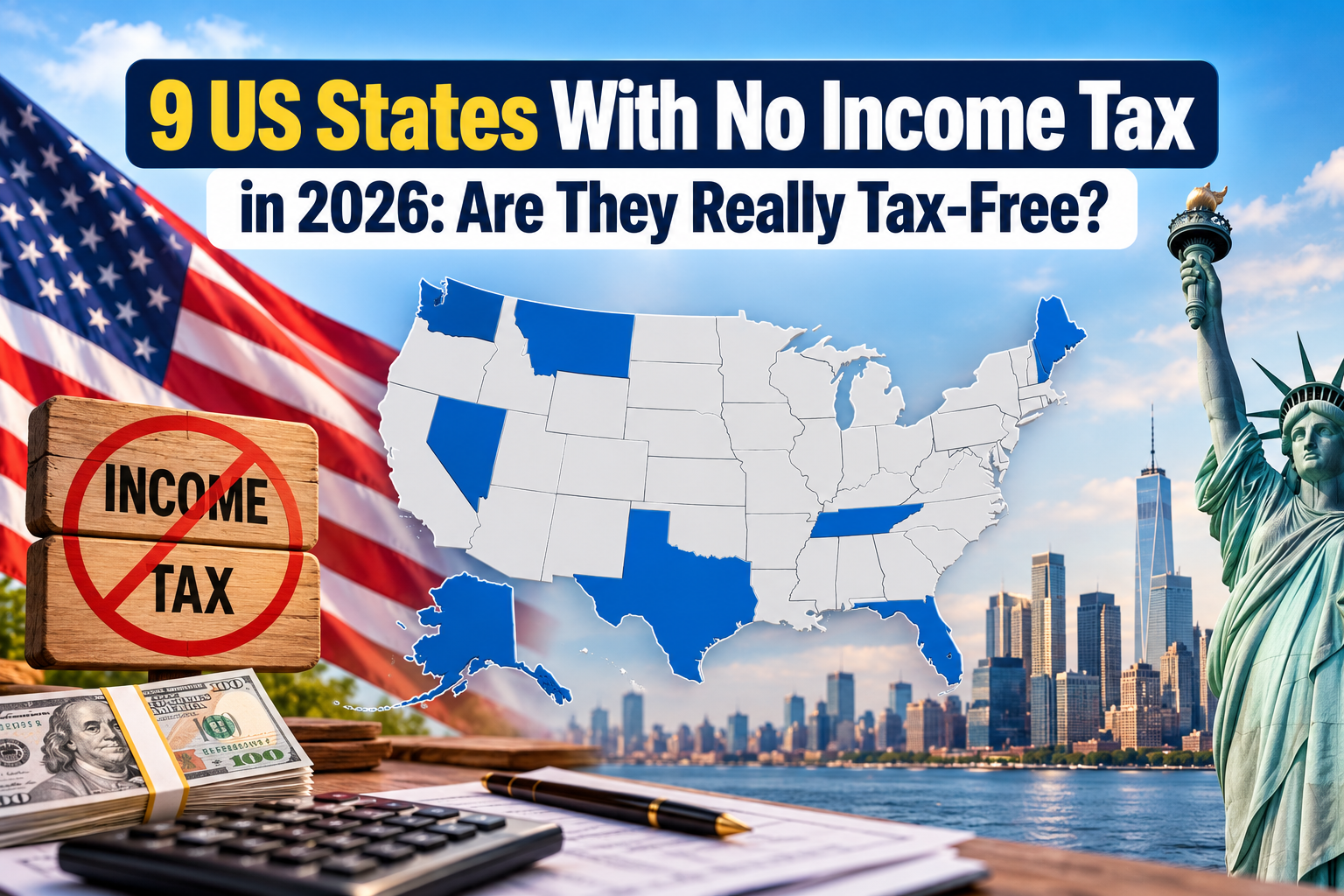
Looking to keep more of your paycheck? For many Americans, reducing the amount paid in state income taxes is one reason to consider moving to a different state. That’s why states with no individual income tax often attract workers, retirees, and people planning a move.
But choosing a state based on income tax alone can be misleading. In this guide, we’ll cover the 9 US states with no income tax in 2026, explain what “no income tax” actually means, and look at the other taxes you may still have to pay—so you can make a more informed decision before relocating.
The 9 US States With No Income Tax in 2026
As of 2026, nine states have no broad-based personal income tax. Each has developed a distinct method for funding its government operations. Understanding these methods provides a clearer picture of the financial environment in each state.
| State | Tax Picture | Economy & Jobs | Cost of Living | Key Consideration |
| Alaska | No state income tax; local sales taxes may apply | Oil, fishing, mining and tourism drive the economy | Higher than average | Remote location can increase everyday and transportation costs |
| Florida | No individual income tax; 6% state sales tax | Strong tourism, agriculture and growing technology sector | Around the national average, but varies by city | Housing can be expensive in major coastal and tourist areas |
| Nevada | No individual income tax; 6.85% state sales tax | Tourism, gaming, entertainment and growing urban industries | Around or slightly above average | Las Vegas and Reno have experienced rising housing costs |
| New Hampshire | No broad individual income tax or sales tax | Manufacturing, healthcare, education and other industries | Above national average | High property taxes can offset some tax savings |
| South Dakota | No individual income tax; sales taxes apply | Agriculture, healthcare and finance are major sectors | Relatively low | Rural areas may have higher transportation and utility costs |
| Tennessee | No individual income tax; relatively high sales tax | Automotive, manufacturing and entertainment support jobs | Below national average | Housing costs are rising in fast-growing cities such as Nashville |
| Texas | No individual income tax; 6.25% state sales tax | Diverse economy spanning technology, energy, agriculture and manufacturing | Below national average overall | Property taxes can be a significant expense for homeowners |
| Washington | No broad individual income tax; sales taxes are significant | Technology, aerospace and agriculture are major economic drivers | Higher than national average | Housing costs are particularly high in major cities |
| Wyoming | No individual income tax; low state sales tax | Energy, mining and tourism play major roles | Generally affordable | Remote communities can face higher healthcare and grocery costs |
The Hidden Costs of No Income Tax States: Property and Sales Taxes
The two biggest revenue generators used to offset the lack of an income tax are property and sales taxes. For many households, these “hidden” costs can completely negate any savings. Your personal financial situation—whether you’re a renter or homeowner, a big spender or a frugal saver—will determine if you come out ahead.
Property Tax in Tax-Free States: The Homeowner’s Burden
If you plan on owning a home, property tax is a non-negotiable, recurring expense that can have a massive impact on your budget. States like Texas and New Hampshire are famous for their lack of income tax but can have high property tax bills. A hefty property tax can feel just like the monthly income tax deduction you were trying to escape.
Let’s look at how some of these states stack up. The table below shows the average effective property tax rates. Remember, these are just averages; rates can vary significantly by county and city.
| State | Average Effective Property Tax Rate | National Rank (1 = Highest) |
| New Hampshire | 1.93% | 3rd |
| Texas | 1.68% | 6th |
| Alaska | 1.03% | 23rd |
| Florida | 0.91% | 26th |
| Washington | 0.87% | 29th |
| Wyoming | 0.56% | 46th |
As you can see, moving to New Hampshire or Texas to avoid income tax could lead to a painful surprise when your first property tax bill arrives.
Sales Tax in No Income Tax States: The Consumer’s Contribution
The other major lever these states pull is sales tax. If you’re a big spender, a high sales tax can eat into your budget every time you buy groceries (in some states), clothes, a car, or go out to eat. This tax is often regressive, meaning it takes a larger percentage of income from lower-income individuals than from high-income earners.
States like Tennessee and Washington rely heavily on what you spend to fund their operations. The table below shows the combined state and average local sales tax rates, which is what you actually pay at the register.
| State | Combined Average Sales Tax Rate | National Rank (1 = Highest) |
| Tennessee | 9.55% | 1st |
| Washington | 9.40% | 4th |
| Nevada | 8.24% | 10th |
| Texas | 8.20% | 12th |
| Florida | 7.02% | 25th |
| Alaska | 1.81% | 46th |
Living in Tennessee might save you on income tax, but you’ll be paying one of the highest tax rates in the entire country on nearly everything you buy.
A Look at the Unique Trade-Offs in Each State
Beyond broad property and sales taxes, each of the nine states has its own unique financial identity and way of paying the bills.
Alaska
Alaska relies heavily on revenue from its massive oil and gas industry. This revenue helps fund the Permanent Fund Dividend (PFD), an annual payment to residents. However, the cost of living is extremely high.
Florida
Florida is a tourism powerhouse, collecting huge sums from sales taxes and tourist development taxes on hotels and rentals. Property insurance costs, however, are among the highest in the nation and can be a major financial burden for homeowners.
Nevada
Nevada is also a tourism-driven economy. Nevada leans on high sales taxes and specific taxes on gaming and entertainment to fund the state.
New Hampshire
New Hampshire has no broad individual income tax and no general sales tax. Its Interest and Dividends Tax was repealed for tax periods beginning after December 31, 2024. The state continues to rely heavily on property taxes and also has business taxes.
South Dakota
This state attracts financial companies with its favorable trust and business laws. For residents, it relies on sales taxes to make up the difference.
Tennessee
Home to the highest average combined sales tax rate in the U.S. What you save on your paycheck, you give back at the cash register.
Texas
A mix of very high property taxes and high sales taxes. It also levies a “franchise tax” on many businesses, which can be a complex and significant cost for entrepreneurs.
Washington
Washington is a high sales tax state that also has one of the highest gasoline taxes in the country. It does not impose a broad individual income tax on wages and salaries, but a capital gains tax applies to certain long-term capital gains.
Wyoming
Wyoming funds itself primarily through severance taxes on its vast mineral resources, like coal and oil, along with sales and property taxes.
So, Who Actually Saves Money in States With No Income Tax?
After looking at the trade-offs, it becomes clear that a no state income tax environment doesn’t benefit everyone equally. The people who are most likely to see a real financial benefit are typically:
High-Income Earners
The more you earn, the more you save from a 0% income tax rate. For someone earning $500,000 a year, avoiding a 5% state income tax means $25,000 in savings, which can easily outweigh higher property or sales taxes.
Retirees with Large Nest Eggs
Retirees living off of 401(k) or IRA distributions (which are treated as income) can save significantly. This is a major reason Florida and Tennessee are popular retirement destinations.
Frugal Spenders and Renters
If you don’t own property and don’t spend a lot on taxable goods, you can more effectively avoid the primary taxes these states use to generate revenue.
Conversely, a middle-income family that wants to buy a home in a good school district in Texas might find that their massive property tax bill wipes out some or all of their income tax savings.
Practical Tips for Choosing a State
Deciding on a state based solely on its income tax policy can be misleading. A person’s financial situation is unique, and the best choice depends on several factors. We recommend a balanced approach that considers the entire financial picture, not just one type of tax.
- Evaluate Your Spending Habits: If you spend a large portion of your income on goods and services, a state with a high sales tax, like Tennessee or Washington, might offset the savings from no income tax. It is helpful to track your spending to estimate potential sales tax costs.
- Consider Property Ownership: For those who plan to own a home, states with high property taxes, such as Texas and New Hampshire, could present a significant annual expense. We suggest researching average property tax rates in the specific counties you are considering.
- Look at the Total Cost of Living: Taxes are just one part of the cost of living. Housing, utilities, transportation, and healthcare costs also vary widely by state. A lower tax burden might be less beneficial if everyday expenses are much higher.
Final Thoughts
Choosing a place to live is a significant decision, and the tax environment is an important component. The nine states without a personal income tax offer a clear benefit for those with high earned income. However, it is essential to understand that these states still collect revenue through other means, such as sales, property, and excise taxes. A complete financial assessment is necessary to determine if a move would be truly advantageous.
Looking ahead to 2026, the tax landscape remains dynamic. New Hampshire’s Interest and Dividends Tax has already been repealed for tax periods beginning after December 31, 2024, showing how state policies can evolve. We encourage anyone considering a move to stay informed about local tax laws and to evaluate how the entire tax structure of a state aligns with their personal and financial circumstances.
