

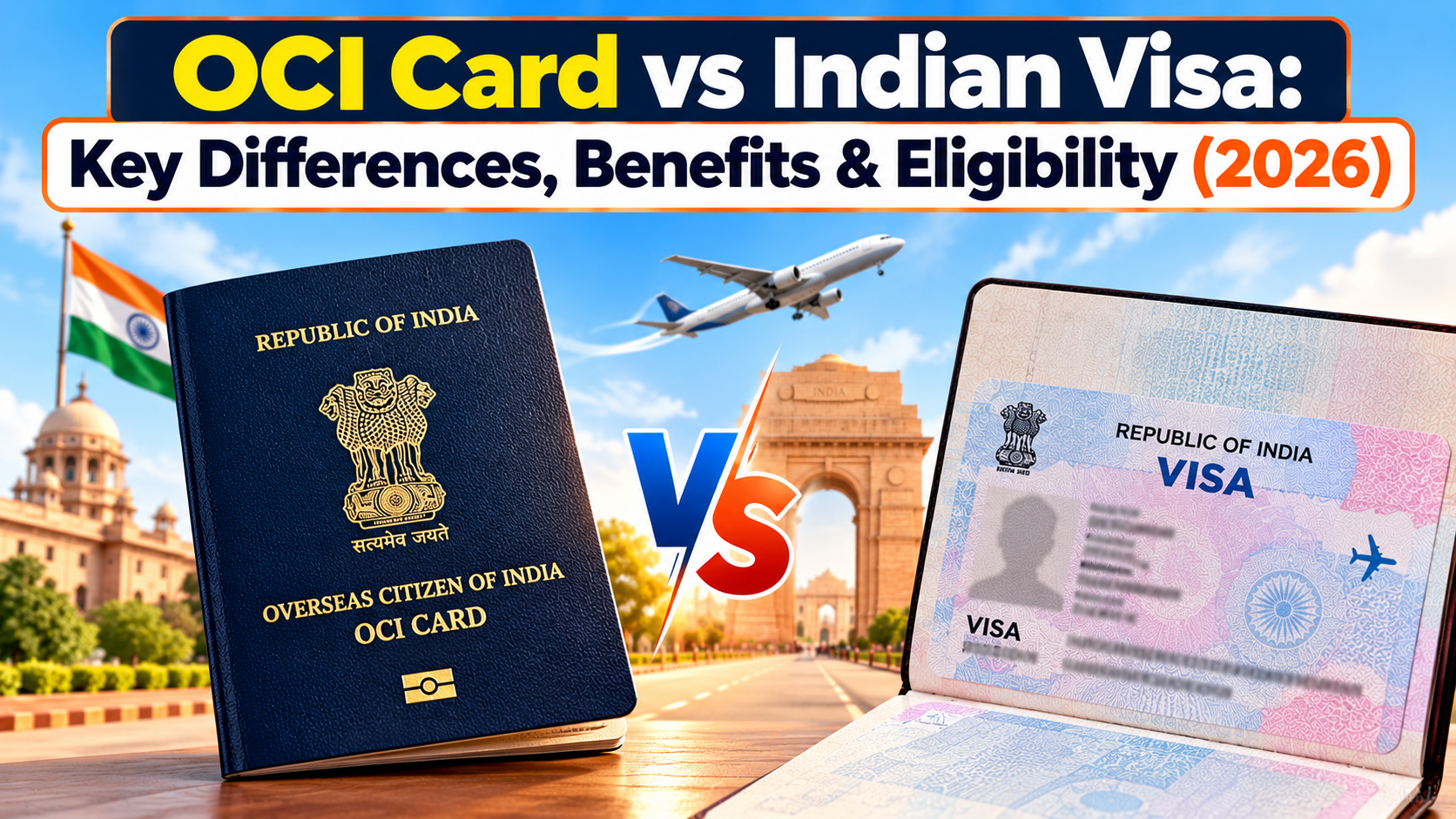
OCI Card vs Indian Visa- Big difference to your travel plans, especially if you have Indian roots and live abroad. An OCI card offers eligible foreign nationals long-term travel benefits, whereas an Indian visa provides permission to enter India for a specific purpose and period.
Although both allow eligible foreign nationals to travel to India, they differ in eligibility, validity, benefits, and application requirements. An OCI card does not grant Indian citizenship or an Indian passport, so understanding these differences is essential before applying.
In this guide, we’ll explain what an OCI card and an Indian visa are, compare their key differences, explore the distinction between NRI and OCI status, and help you understand which option may suit your needs in 2026. We’ll also cover common application mistakes to help you make an informed decision.
What Is an OCI Card?
An Overseas Citizen of India (OCI) card is a lifelong visa facility for eligible foreign citizens of Indian origin that allows them to enter and stay in India without applying for a visa for every trip.
Key Features of an OCI Card
- Lifetime Validity: Generally valid for the holder’s lifetime, subject to applicable rules.
- Multiple Entries: Allows multiple entries into India.
- Long-Term Stay: Enables eligible holders to stay in India without a fixed visa duration.
- No Indian Citizenship: Does not grant Indian citizenship or an Indian passport.
- Limited Rights: OCI cardholders cannot vote or hold certain constitutional positions in India.
- Land Ownership Restrictions: Generally cannot purchase agricultural land, plantation property, or farmhouses in India.
- Travel Convenience: Suitable for eligible people of Indian origin who visit India frequently.
What Is an Indian Visa?
An Indian visa is an official authorization that allows a foreign national to enter India for a specific purpose and period, subject to the visa conditions.
Key Features of an Indian Visa
- Limited Validity: Valid for a specified period, depending on the visa type.
- Different Categories: Includes tourist, business, medical, and student visas.
- Entry Conditions: May allow single or multiple entries, depending on the visa.
- Purpose-Specific: Must be used according to the conditions of the visa issued.
- Temporary Permission: Does not provide lifelong entry privileges like an OCI card.
- Renewal or Reapplication: A new visa or an eligible extension may be required, depending on the circumstances.
- Suitable for Short Visits: Useful for foreign nationals visiting India for tourism, business, medical treatment, or education.
OCI Card vs Indian Visa: Key Differences, Benefits & Eligibility
The following table shows the main differences between OCI Card and Indian Visa to help with this decision.
| Feature | OCI Card | Indian Visa |
| Eligibility | Foreign citizens of Indian origin who were eligible to become citizens of India on January 26, 1950, or belonged to a territory that became part of India after August 15, 1947. Spouses and minor children of such persons are also eligible. Citizens of Pakistan and Bangladesh are generally not eligible. | Any foreign national who meets the criteria for a specific visa category (e.g., tourist, business, student). Eligibility is not based on Indian heritage. |
| Validity | Lifelong. The OCI card itself does not expire. However, it needs to be re-issued when a new passport is obtained up to the age of 20 and once after the age of 50. | Temporary and varies by visa type. Validity can range from 30 days for an e-Tourist visa to 10 years for a long-term tourist or business visa. |
| Purpose of Visit | Multi-purpose. Allows for tourism, business, study, research, and residence without restriction. Special permission is needed for certain activities like mountaineering or missionary work. | Purpose-specific. A tourist visa cannot be used for business, and a business visa cannot be used for employment. The purpose must be declared during the application. |
| Benefits and Rights | Exemption from registering with the Foreigners Regional Registration Office (FRRO) for any length of stay. Parity with NRIs in economic, financial, and educational fields. Can own non-agricultural property. | Limited to the permissions granted by the specific visa. Long-term visitors may need to register with the FRRO. No property ownership rights are granted. |
| Application Process | A more detailed process requiring proof of Indian origin. Processing time is generally longer, often taking several weeks or months. | Simpler and faster process. E-visas can be processed within 72 hours, while standard visas take a few days to a couple of weeks. |
Let’s understand the difference with an example.
Example:
Suppose Priya and Neha both live in the USA.
- Priya is an NRI: She moved to the USA for work but kept her Indian citizenship and Indian passport. She can return to India using her Indian passport.
- Neha is an OCI cardholder: She became a US citizen and no longer holds Indian citizenship. Since she qualifies for OCI, she uses her US passport and OCI card to travel to India.
So, what is the actual difference?
The difference is not simply where you live. It is whether you still hold Indian citizenship.
- If you live in the USA but remain an Indian citizen, you may be an NRI.
- If you become a foreign citizen and qualify for OCI registration, you can apply for an OCI card.
- You cannot hold Indian citizenship and OCI status at the same time.
Remember: You don’t apply to become an NRI just because you live abroad. NRI status depends on the applicable rules, while OCI requires a separate application and approval.
NRI vs OCI: Which Option Is Best- 2026 realities
- Choose NRI status: If you are an Indian citizen living abroad and want to retain your Indian citizenship.
- Consider OCI: If you have acquired foreign citizenship, surrendered Indian citizenship where required, and meet the OCI eligibility criteria.
Important: NRI and OCI are not interchangeable options. An Indian citizen cannot hold OCI status simultaneously. Also, becoming an NRI does not require a separate application; NRI status for tax purposes is determined under the applicable residency rules.
Expert Tips
- Verify Information on Official Websites: Always use the official Government of India websites for OCI services or visa applications. Third-party sites may contain outdated information or charge unnecessary fees. Official sources provide the most current guidelines and forms.
- Prepare Digital and Physical Copies: Before starting an application, scan all required documents, such as your passport, photograph, and proof of origin. Keep both digital copies for online submission and physical copies for potential verification at the consulate or embassy.
- Apply Well in Advance: Processing times can vary. For an OCI card, the process can take two to three months. For visas, while e-visas are quick, it is wise to apply at least a month before your planned travel date to account for any unexpected delays.
Related Article
- How to Apply for OCI from Inside India (2026 FRRO / e-FRRO Guide)
- E-Arrival Card for OCI Holders in USA: 2026 Guide
