

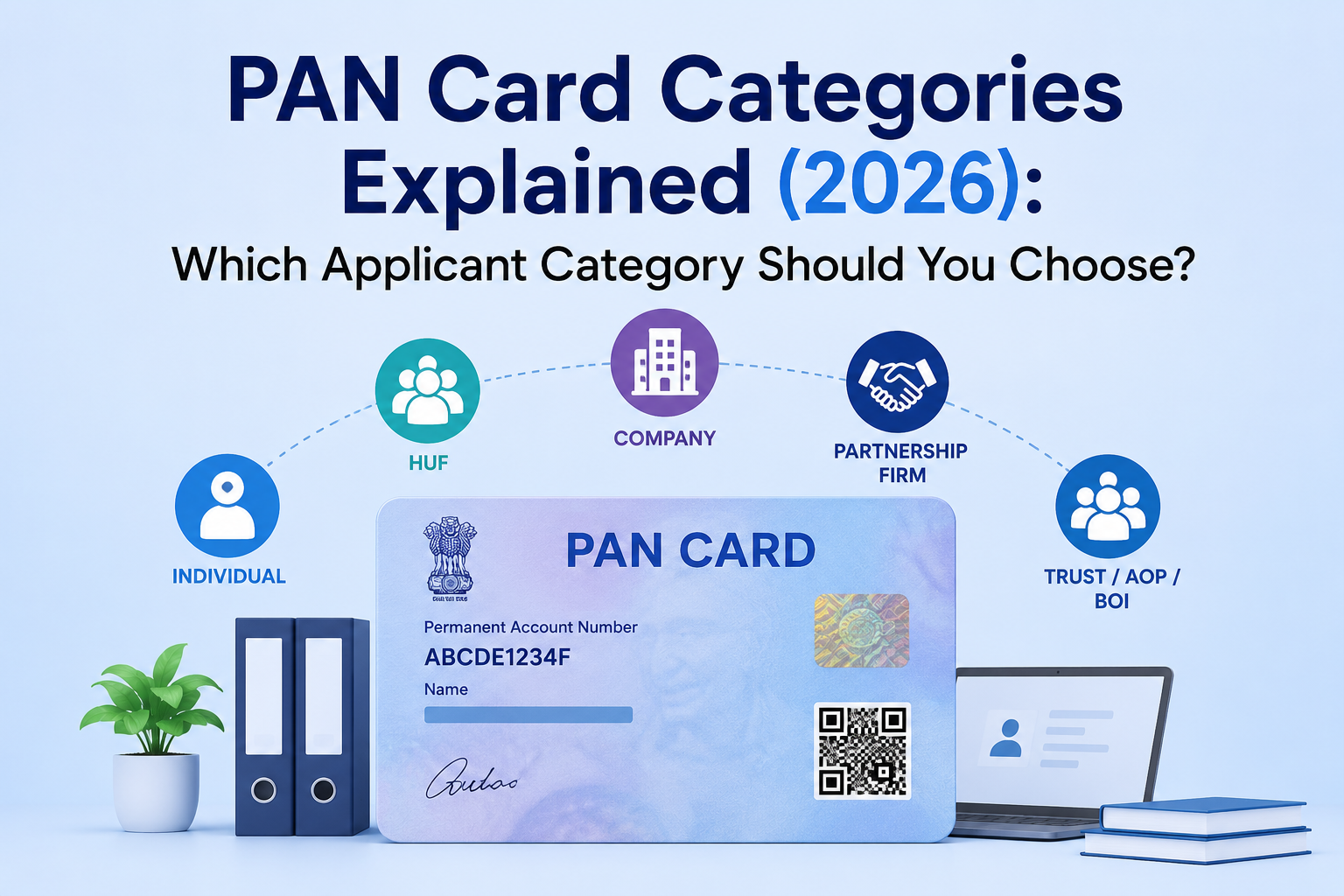
A Permanent Account Number (PAN) is a unique 10-digit alphanumeric identification number issued by the Income Tax Department of India. It is required for filing income tax returns, claiming tax refunds, opening bank accounts, registering businesses, and carrying out various financial transactions.
The Income Tax Department offers different PAN Card categories for individuals and entities, including Individuals, HUFs, Companies, Partnership Firms, Trusts, and Societies. Choosing the correct PAN Card applicant category is an important step, as it determines the type of PAN you should apply for and helps avoid delays or rejection of your application.
In this guide, you’ll learn about each PAN Card category, who it is meant for, and how to choose the right one based on your requirements.
Expert Tip
Before selecting an applicant category, first identify who the PAN is being issued for. The correct category depends on the legal status of the applicant—not on the purpose of applying for a PAN. Choosing the right category from the beginning helps avoid document mismatches and application delays.
Types of PAN Cards
Applicants are confused here because there are different physical types of PAN cards and all are same as look wise. Only you have to choose the applicant category while submitting your PAN application.
Your applicant category tells the Income Tax Department what type of entity you are. For example, you may apply as:
- Individual PAN
- Hindu Undivided Family (HUF) PAN
- Company PAN
- Partnership Firm PAN
- Trust PAN
- Society or Association of Persons (AOP) PAN
- Other eligible entities PAN
Choosing the right PAN card category is important because it determines your tax identity, compliance requirements, and the documents needed for your PAN application.
The First Choice: Form 49A or Form 49AA?
Before you even get to the categories, you must select the correct application form. Your choice depends entirely on your citizenship and where your entity is registered.
| Form Type | Who Should Use It? | Simple Guideline |
| Form 49A | For all Indian citizens, including NRIs (Non-Resident Indians) and entities incorporated or formed within India. | If you are an Indian citizen or your business/organization was created in India, this is your form. |
| Form 49AA | For foreign citizens and entities incorporated or formed outside of India who need a PAN to conduct financial transactions in India. | If you are a foreign national or your company is registered abroad (e.g., in the USA or UK), you must use this form. |
PAN Card Categories Explained: Which Applicant Category Should You Choose?
Anyone required to pay taxes or carry out financial transactions in India can apply for a PAN Card under the appropriate applicant category, depending on their legal status.
Before selecting your category, ask yourself one simple question:
“Who is this PAN being issued for?”
Use the table below for a quick answer.
| Applicant Type | Choose This PAN Category |
| Salaried Employee | Individual |
| Student | Individual |
| Minor | Individual |
| NRI / OCI Card Holder | Individual |
| Sole Proprietor | Individual |
| Partnership Firm | Firm |
| Limited Liability Partnership (LLP) | Firm |
| Private Limited / Public Limited Company | Company |
| Hindu Undivided Family | HUF |
| Trust | Trust |
| Society / Association | Association of Persons (AOP) or applicable category |
Below is a detailed explanation of every PAN Card category with eligibility, practical examples, and common mistakes to help you select the correct applicant status.
Individual PAN card
Who should choose this category?
Select Individual if the PAN is being issued in your personal name.
This category is suitable for:
- Salaried employees
- Self-employed professionals
- Freelancers
- Students
- Minors
- Senior citizens
- NRIs
- OCI Card holders
- Sole proprietors
Example
Rahul works in a private company and wants to file his Income Tax Return. He should apply as an Individual.
Similarly, Priya runs a boutique as a sole proprietor. Even though she owns a business, she should still choose Individual because a proprietorship is not a separate legal entity.
💡 Quick Tip: If the PAN is in your own name, the correct category is usually Individual.
⚠️ Common Mistake: Many business owners search for a separate “Proprietorship” category. No such category exists. Sole proprietors must apply as Individual
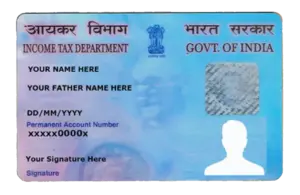
Hindu Undivided Family (HUF) PAN Card
Who should choose this category?
Select HUF if the PAN is being issued for a Hindu Undivided Family and not for an individual family member.
The application is submitted by the Karta, who represents the HUF.
Example
- Example: The Sharma family runs an ancestral business. Mr. Sharma, as the Karta, applies for a HUF PAN card to file tax returns for the income generated by the family’s joint assets.
💡 Quick Tip: An HUF has its own PAN and files tax returns separately from its members.
⚠️ Common Mistake: Don’t select HUF simply because you belong to a Hindu family. The category is only for a legally recognised Hindu Undivided Family.
Company PAN Card
Who should choose this category?
Choose Company if the PAN is being issued for a business registered under the Companies Act, such as:
- Private Limited Company
- Public Limited Company
- One Person Company (OPC)
Example
ABC Technologies Private Limited needs a PAN to open a current bank account and file taxes. It should apply under the Company category.
💡 Quick Tip: Every registered company must have its own PAN, separate from its directors.
⚠️ Common Mistake: Partnership firms and LLPs should not choose this category.
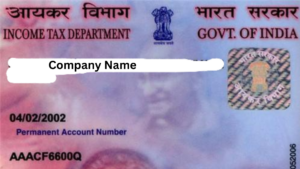
💡 Want to know the complete process? If you’re planning to apply for a Company PAN Card, read our detailed guide on Company PAN Card – Documents, Eligibility & Application Process to learn about the required documents, eligibility criteria, fees, and step-by-step application process.
Firm (Including LLP) PAN Card
Who should choose this category?
This category is for:
- Partnership Firms
- Limited Liability Partnerships (LLPs)
Example
Three architects start an LLP called Design Studio LLP. The LLP should apply under Firm.
💡 Quick Tip: LLPs use the Firm category—not Company.
⚠️ Common Mistake: Many LLP owners mistakenly select Company instead of Firm.
Association of Persons (AOP) PAN Card
Who should choose this category?
Choose this category when two or more persons voluntarily come together for a common purpose and earn income jointly.
Example
A group of investors jointly undertakes a commercial project and earns profits together. They may apply as an Association of Persons (AOP).
💡 Quick Tip: An AOP is created intentionally to earn income together.
Trust PAN Card
Who should choose this category?
This category applies to:
- Charitable Trusts
- Religious Trusts
- Educational Trusts
- Private Trusts
Example
A charitable trust collecting donations for education should obtain its own PAN under the Trust category.
💡 Quick Tip: Trusts require a separate PAN to manage their financial and tax obligations.
Body of Individuals (BOI) PAN Card
Who should choose this category?
A BOI generally consists of two or more individuals who jointly earn income, often due to co-ownership or inheritance.
Example
Two siblings inherit a commercial property and earn rental income together. Depending on their circumstances, the income may be assessed as a Body of Individuals (BOI).
💡 Quick Tip: Unlike an AOP, a BOI often arises due to ownership or inheritance rather than a planned business arrangement.
Local Authority PAN Card
Who should choose this category?
Local government bodies such as:
- Municipal Corporations
- Municipal Councils
- Panchayats
- District Boards
Example
A Municipal Corporation requires a PAN to manage its financial transactions.
Artificial Juridical Person (AJP)
Who should choose this category?
This category applies to legal entities that are recognized as persons under law but do not fall into any other PAN category.
Example
Certain statutory authorities, universities, temple deities recognized by law, and similar entities may apply under this category.
Government PAN Card
Who should choose this category?
Central Government and State Government departments requiring a PAN for official purposes should select this category.
Example
A government department opening a bank account or carrying out financial transactions may require a PAN under the Government category.
Expert Note: The applicant category should always be selected based on the legal status of the applicant, not on the purpose of applying for a PAN. If you’re unsure, refer to the official PAN application instructions or seek professional guidance before submitting your application.
What if Your PAN Status Changes?
A common question is whether you can change your PAN category. The answer is no. A PAN is permanent and linked to the legal entity it was issued to.
For instance, if you have an Individual PAN for your sole proprietorship and later register your business as a Private Limited Company, you cannot “convert” your individual PAN. The new company is a separate legal entity. You must apply for a new PAN under the “Company” category. Your individual PAN remains with you for your personal tax obligations.
Conclusion
Choosing the correct applicant status is the most critical step in the PAN application process. It defines your legal and financial identity in the eyes of the Income Tax Department. Using the examples and explanations above, you can confidently identify your specific category, whether you are an individual, a HUF, a company, or any other entity. An incorrect selection will only lead to a rejected application and unnecessary delays.
Ready to apply? Double-check your category and proceed to the official NSDL or UTIITSL portal to fill out the correct form. Getting it right from the start saves you time, effort, and potential compliance issues down the road.
Sources
