

Have you ever been asked to enter a TIN or Tax Identification Number while filling out a tax form, opening a financial account, or applying for a PAN card in India? Then you definitely come to right place.
Here in this Guide we explain what a TIN is, how it works, how to find or apply for one, and when you actually need it.
What Is a Tax Identification Number (TIN)?
A TIN (Tax Identification Number) is a unique number issued by a country’s tax authority to identify individuals, businesses, and other entities for tax-related purposes.
It helps tax authorities track taxpayers, manage tax records, and ensure compliance with tax regulations. In some countries, it is also referred to as a Taxpayer Identification Number.
Who issues a TIN?
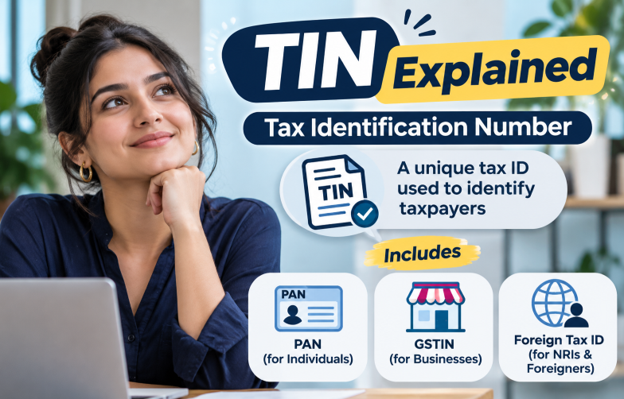
A TIN is generally issued by the government’s tax authority in the country where a person or business is registered for tax purposes.
For example:
- India: Income Tax Department
- USA: Internal Revenue Service (IRS)
- UK: HM Revenue & Customs (HMRC)
- Canada: Canada Revenue Agency (CRA)
- Australia: Australian Taxation Office (ATO)
Who receives a TIN?
- Individuals who earn income or pay taxes.
- Businesses and companies.
- Trusts and other legal entities.
- People who register for tax purposes.
- Individuals who receive a tax ID at birth or when obtaining a national ID in some countries.
Is TIN the same in every country? No. “TIN” is a general label, not one universal number. Each country decides its own format, name and rules.
A simple example: Imagine a person who lives in the US and has an SSN for tax purposes. When a bank elsewhere asks for their “TIN”, that SSN is the number they give. The same person may also hold an Indian PAN, which is their tax number in India. Both are tax identification numbers, issued by different countries for different tax systems.
What Is the Purpose of a TIN Number?
Governments use tax identification numbers because names alone are unreliable. Many people share the same name, spellings change, and addresses move. A unique number helps tax authorities identify each taxpayer accurately.
Here are the following Uses of TIN number:
- A TIN helps tax authorities identify each taxpayer and prevent duplicate tax records.
- It helps link income tax returns to the correct individual or business.
- It ensures that TDS, withholding tax and advance tax payments are credited to the right taxpayer.
- It helps banks and financial institutions report financial transactions to tax authorities.
- It allows countries to exchange financial information and prevent international tax evasion.
- It helps maintain accurate records of tax payments, liabilities and refunds.
- It makes tax administration and compliance easier for individuals and businesses.
What Are the Different Types of TIN?
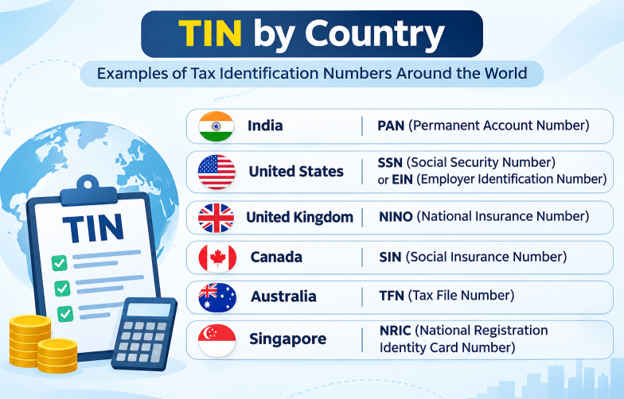
Here are the different types of TIN:
| Country | Tax identification number / example |
| United States | SSN / ITIN |
| United Kingdom | UTR and other applicable identifiers |
| Canada | SIN |
| Australia | TFN |
| India | PAN |
Important: These numbers are not universally interchangeable. Whether a number counts as a TIN depends on the country’s official tax rules. Always check what the requesting institution accepts.
What Is the Difference Between TIN, PAN, SSN and ITIN?
Here is a quick comparison between TIN, PAN, SSN and ITIN:
| Term | Meaning | Purpose |
| TIN | Tax Identification Number | General tax identification |
| PAN | Permanent Account Number | Indian taxpayer identification |
| SSN | Social Security Number | US social security and identification |
| ITIN | Individual Taxpayer Identification Number | US federal tax processing for eligible individuals |
What this means in practice:
- TIN is a general term, not one universal number: It is the category, and the actual number depends on the country.
- PAN is India’s tax identification number for taxpayers: If a form asks for your Indian TIN, it means your PAN.
- SSN and ITIN belong to the US system: An ITIN is generally for people who must file US taxes but are not eligible for an SSN.
- Not every SSN or national ID is automatically accepted as a TIN in every country: Acceptance depends on that country’s rules.
When Do You Need a Tax Identification Number?
You will usually be asked for a TIN in situations like these:
When Filing Income Tax Returns
Returns are filed against your tax number. If you earn in more than one country, you may need a number for each.
When Opening Financial Accounts
Banks and financial institutions routinely ask for your tax residency details and TIN. This is common when opening NRE/NRO accounts or accounts abroad.
When Making Certain Financial Investments
Mutual funds, brokerages and similar platforms may ask for a TIN during KYC. An NRI investing in India, for instance, is often asked for country-of-residence tax details.
When Completing International Tax Documentation
Forms related to international tax reporting and residency declarations often have a dedicated TIN field. Leaving it blank or entering something wrong can delay processing.
When Applying for an Indian PAN Card as a Foreign Citizen or NRI
The PAN application includes a field for the applicant’s tax identification number in the country of residence. How it applies depends on your citizenship and the form you use, which we cover below.
What Is TIN in India? Is It the Same as PAN?
If you search “TIN in India”, you might land on something completely different from what this article has covered so far, because TIN has two meanings in the Indian context.
- Taxpayer Identification Number. This is the general meaning discussed throughout this guide. For an individual in India, the equivalent identifier is PAN.
- Tax Information Network. This is a system within India’s tax administration that handles the collection, processing and tracking of tax-related information, including tax payments and returns. Protean (formerly NSDL e-Governance) is known for operating this network and for its related services.
The difference: The Tax Information Network is an Indian tax infrastructure. A foreign TIN is an individual’s tax number in another country. They are completely unrelated, and the shared abbreviation is just a coincidence.
So, if someone says “TIN” in a PAN application context, they mean the tax identification number from your country of residence, not the Tax Information Network. Keeping the two apart saves a lot of confusion.
