

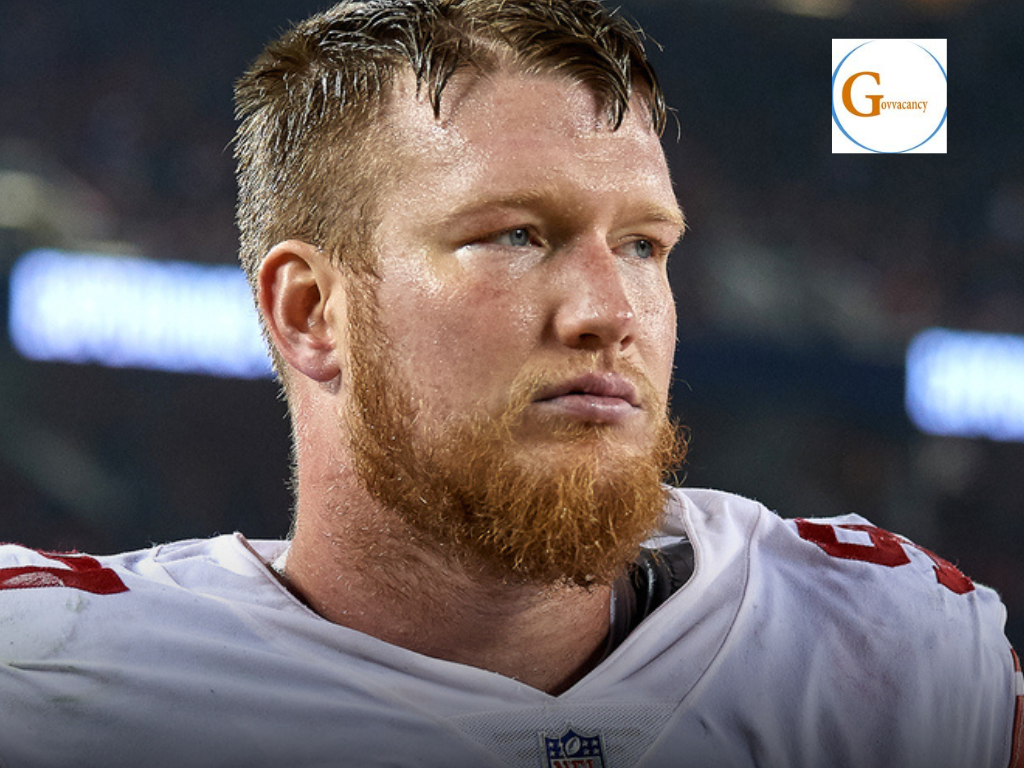
Josh Mauro, the former NFL defensive end who played eight seasons across five teams, died on April 23, 2026. He was 35 years old. No cause of death has been released. This is not a recap of his career stats. Every outlet already has that. This is about three words his girlfriend posted on Facebook that nobody is talking about.
When Josh Mauro’s father, Greg, announced his son’s death on April 28, the statement was the kind of writing that comes from a person trying to hold themselves together at the center of something that cannot be held.
“With many tears and broken hearts,” Greg wrote, “yet anchored in the unshakable certainty that our precious Josh Mauro is now healed and made new — living in the presence of the Lord — we humbly covet your prayers as our family walks through the devastating loss of our amazing son, brother, uncle, grandson and friend.”
Every sports outlet covered that quote. It was the lede on TMZ, Fox News, NBC Sports, Yahoo Sports, ESPN, and a dozen others.
But there was a second statement. Shorter. Four words, posted on Facebook by Linzay Crawford — Josh Mauro’s girlfriend.
“I know you’re finally at peace.”
Not one outlet stopped to ask what that meant.
What “Finally” Carries With It
The word finally is doing a lot of work in that sentence.
Finally implies a before. It implies waiting. It implies something that had not yet arrived — something longed for, struggled toward, perhaps fought against.
“I know you’re at peace” is a statement of comfort. “I know you’re finally at peace” is something else entirely. It suggests that peace had been elusive. That the man those outlets described in clean career-arc sentences — undrafted, 8 seasons, 130 tackles, 5 sacks — had been carrying something heavier than his stats.
We don’t know what that something was. His family has not said. The cause of death remains undisclosed. Speculation is not the point of this piece.
The point is that three words from the person who knew him most intimately were published, noticed, and immediately bypassed in the rush to file the same article that every other outlet was filing.
You may also Like- Detroit Lions Trade David Montgomery to Houston Texans in Surprise Offseason Move
The Gap Between the Box Score and the Man
Here is what we know about Josh Mauro’s life between 2021 — when he last appeared on an NFL roster — and April 23, 2026, the day he died:
Nothing. Not a word. Five years, total silence from every major sports publication.
That silence is not unusual. It is, in fact, the norm.
The sports media ecosystem is built to cover players while they are playing. The moment a fringe roster player — what the Arizona Cardinals’ site affectionately called a “belly-of-the-roster player” — stops appearing on a depth chart, the coverage stops too. The cameras leave. The beat writers move on to whoever took your roster spot.
For players like Josh Mauro — not a star, not a Pro Bowler, not a face of a franchise, but a deeply reliable professional who spent eight years holding down a job that most people never come close to holding — that transition can be extraordinarily difficult.
The NFL Players Association has written plainly about this: “Football players are at a high risk for losing this sense of identity after they retire, because for most of our lives, the praise and admiration we’ve received has been because of football.”
Research from Harvard’s Football Players Health Study found that former players consistently described the end of their careers as a “terrible loss” — a loss not of income or status alone, but of identity, structure, daily purpose, and the deeply embedded social world of the locker room. One player quoted in the study described it plainly: “All of a sudden no matter what your degree was in college, no matter what it was, your identity all along was that you were a football player. And all of a sudden you’re not.”
Former quarterback Trent Green told ESPN something similar that has stayed relevant for over a decade: “The hardest part is your daily routine. For 15 years, I knew exactly what I was doing in March, June and September because there was a schedule. When you take that away, you suddenly have a lot more time on your hands.”
Read that full ESPN investigation on NFL player depression after retirement →
The Weight of Being the Guy Who Stays Ready
What was particular about Josh Mauro’s career — and what made him different from the stars who struggle with this same transition — is that his entire NFL existence was built around availability.
Adrian Wilson, the former Cardinals safety who was part of Arizona’s front office during Mauro’s stints there, said it better than any analyst could: “Always in shape, always was ready to go wherever he got that call. One of the things I respected most about him. You could depend on him.”
J.J. Watt, who played alongside Mauro with the Cardinals, posted simply: “We’re losing way too many, way too young.”
Think about what that identity requires. Not stardom — but constant preparedness for a call that may never come. Mauro was suspended twice under the NFL’s performance-enhancing drug policy — once in 2018 with the Giants, again in 2020 with the Jaguars — setbacks that would have ended lesser careers, but that he came back from each time. He spent time on practice squads. He was signed and released more times than most people change jobs in a decade.
His career, in other words, was eight years of proving himself to people who weren’t fully convinced.
And then, in 2021, the call stopped coming.
What the Numbers Can’t Capture
Here is what the career stats actually say, since every outlet mentioned them:
- 80 career games, 40 starts
- 130 combined tackles (87 solo)
- 5 sacks, 5 passes defended
- 20 tackles for loss, 2 forced fumbles
What those numbers don’t say is what it costs to produce them as an undrafted player. According to data compiled by RunRepeat, the average NFL career for players who make opening-day rosters is around 6 years — and that’s for drafted players. Undrafted free agents, who have no guaranteed roster spot, no signing bonus of consequence, and no draft capital invested in them by a team that wants to justify keeping them, wash out at a far higher rate.
Mauro lasted 8 seasons. From the hardest starting point available.
The CBS Sports all-time undrafted team is full of household names — Kurt Warner, Tony Romo, James Harrison, Jason Peters. Mauro will never appear on that list. But the players between the legends and the practice-squad cuts — the ones who made 80 games without a Pro Bowl — are arguably the ones who worked hardest for every single snap.
The Five Years Nobody Covered
Between his final game with the Cardinals in 2021 and his death in April 2026, Josh Mauro was 30, then 31, then 32, then 33, then 34, then gone at 35.
What was he doing? We don’t know. What was he struggling with? We don’t know. Was he at peace? His girlfriend’s four words suggest he wasn’t — not for a while, and perhaps not until the very end.
This is not a criticism of Josh Mauro. It is a criticism of how we cover — or refuse to cover — the lives of athletes once they stop being useful to the sports entertainment machine.
The NFL has invested heavily in its mental health infrastructure in recent years, including programs specifically targeting retired players: therapy, career coaching, addiction support, family counseling, and a mentoring system pairing new retirees with veterans who’ve made successful transitions. These are meaningful efforts. They are also, for a significant number of former players, not enough — or not reached in time.
The NFLPA’s own mental health resources page acknowledges this: “Our careers give us recognition, pride and a sense of purpose. But it can be dangerous if being a ‘famous’ football player is the only source of those things.”
For players like Josh Mauro — who was famous enough to have a Wikipedia page, not famous enough for anyone to write about what he was doing in 2024 — that danger is most acute precisely because the support systems are designed around players who are still in the league, or who were stars recognizable enough to attract media attention when they struggle.
The belly-of-the-roster player falls into no category that generates clicks.
The Only Quote That Matters
Before his best season with the Cardinals in 2016 — 13 starts, 42 tackles, 13 tackles for loss — Josh Mauro said something that has been quoted in nearly every obituary written about him this week.
“It’s bigger than you making plays, it’s bigger than getting your name called, it’s bigger than the newspaper having your numbers.”
He said this about football. About being a teammate. About subordinating the self to the team.
It is a beautiful thing to say. It is also, in retrospect, a window into a man who had spent his entire career making himself smaller — more useful, less visible, always ready, never recognized.
Whether that created peace, or cost it, we will never know.
What we do know is that Linzay Crawford — the person who loved him and knew him best — did not say he was at peace when the game was good. She said he was finally at peace when it was over.
If You’re a Former Player Reading This
The NFL Life Line is available 24/7, free, and confidential: 1-800-506-0078.
The NFLPA’s Trust program offers former players tuition reimbursement, brain and body assessments, career counseling, and therapy access. You do not have to have been a star to use it. You have to have played. That’s all.
And if you’re not a former player but you recognize the feeling — the structure gone, the identity uncertain, the question who am I now? — those feelings belong to a lot of people, not just athletes. The 988 Suicide and Crisis Lifeline is available to anyone. Call or text 988.
A Note on What We Owe Athletes We Watched
Every time you watched Josh Mauro play a snap — on a Cardinals defense in 2016, in a Giants uniform in 2018, on a Raiders practice field in 2019 — you were watching a man who had fought harder than most drafted players ever needed to fight just to be on that field.
We covered his death in the same format we cover every former player’s death: announcement, career timeline, stat line, tributes, done.
What we didn’t do — what almost no one did — was stop on four words posted by a grieving woman who loved him and ask what they meant.
“I know you’re finally at peace.”
Rest well, Josh Mauro.
Sources cited in this article:
- Newsweek — Josh Mauro death and girlfriend’s statement
- AZ Cardinals official tribute
- NFLPA Mental Health Matters
- ESPN — Depression in former NFL players
- Harvard Football Players Health Study
- RunRepeat — NFL career length statistics
- CBS Sports — Greatest undrafted players
- The Sports Economist — NFL Mental Health 2026
- ESPN — Life after NFL
