

PAN Card for OCI: A PAN card is a unique ten-digit alphanumeric identifier issued by the Indian Income Tax Department.
It is used in every financial matter, such as opening a bank account, buying property, or investing in India; a PAN card is an important document, whether you are an NRI, OCI holder, or Indian resident. But the question is, can an NRI or OCI cardholder get a PAN card in India?
The answer is yes, they can. However, the application process is different from that for Indian citizens, and using the wrong form or documents can lead to delays or rejection.
In this guide, we’ll explain PAN card eligibility for OCI holders, why you may need one, how to apply, the documents required, validity rules, and common mistakes to avoid.
Key Takeaways
| Item | Details |
| Eligibility | OCI cardholders are fully eligible to apply for a PAN card. |
| Application Form | The correct form to use is Form 49AA, which is designated for foreign citizens. |
| Primary Use | A PAN card is required for financial transactions, investments, property dealings, and filing income tax in India. |
| Validity | The PAN card is valid for life and does not expire. |
What Is a PAN Card and Why Is It Important?
A Permanent Account Number (PAN) is a unique 10-character number issued by the Income Tax Department of India. It helps the government track your financial activities, such as tax payments, investments, and high-value transactions. In simple terms, PAN acts as your financial identity in India.
Important: There is no separate “OCI PAN card” or “NRI PAN card” — the number, the card format, and its legal standing are identical for every category of applicant. The only thing that differs is the application form and the supporting documents required, based on the applicant’s citizenship.
Can an OCI Cardholder Apply for a PAN Card?
Yes, OCI (Overseas Citizen of India) cardholders can apply for a PAN card, and it can be important for managing their financial activities in India. But the application process for OCI cardholders is distinct from that for Indian citizens. They must use Form 49AA, which is specifically designed for foreign citizens and entities, and the application can be submitted online through the official portals of NSDL e-Governance or UTIITSL.
Why Do OCI Cardholders Need a PAN Card?
The following are the Common situations where OCI cardholders need a PAN card:
- Opening an NRO bank account in India or an NRE bank account
- Buying or selling property in India, where PAN is mandatory for registration and for TDS compliance on the transaction.
- Investing in Indian mutual funds, stocks, or fixed deposits, especially where the investment amount exceeds regulatory thresholds.
- Repatriating funds or sale proceeds out of India, since banks require PAN to process large outward remittances.
- Avoiding higher TDS rates. Without a PAN, banks and other deductors are required to withhold tax at a higher flat rate rather than the applicable slab rate.
- Filing an Indian income tax return, if you have taxable income sourced in India (rental income, capital gains, interest, etc.).
- Claiming DTAA (Double Taxation Avoidance Agreement) benefits, where PAN is typically used alongside a Tax Residency Certificate and Form 10F.
In short, if there’s any financial footprint in India — even a single bank account or an inherited property — a PAN card is close to unavoidable.
Benefits of a PAN Card for OCI Holders
Having a PAN card for OCI provides you with many benefits, like:
- Property Transactions: Acquiring or selling any immovable property in India valued above a certain threshold legally requires quoting a PAN. In our day-to-day work, we see that without it, property registration cannot proceed, making it a non-negotiable first step for any real estate investment.
- Investing in India: If you intend to invest in Indian mutual funds, stocks, or bonds, a PAN is mandatory. It’s required to open a Demat and trading account, which are the gateways to participating in the Indian securities market. This is a strict regulatory requirement from SEBI.
- Banking Operations: While you can open a basic NRO/NRE account without a PAN initially, many high-value transactions, fixed deposits exceeding ₹50,000, and other banking services will necessitate one. It also helps banks deduct Tax at Source (TDS) at the correct rates.
- Filing Income Tax Returns: Should you have any taxable income in India—such as rental income from property or capital gains from investments—a PAN is essential for filing your tax returns. It is the fundamental identifier for all tax-related matters with the government.
How to Apply for a PAN Card for an OCI Card?
Here’s the process from start to finish:
- Choose your application channel. PAN applications for foreign citizens are processed through two government-authorised agencies: Protean (formerly NSDL) and UTIITSL. You can apply directly through either portal, or use a private facilitation service if you’d rather not handle the paperwork yourself.
- Fill out Form 49AA. This is the correct form for OCI cardholders, since it applies to anyone who is not an Indian citizen. Form 49AA asks for details a citizenship form doesn’t need — your citizenship type (OCI/PIO/foreign national), your foreign Tax Identification Number, and full passport details.
- Upload or attach your documents. You’ll need identity proof, address proof, and date-of-birth proof (more on this below).
- Choose your signing method.
-
- e-Sign / digital route: Upload scanned copies of your documents and sign digitally. This is the fastest and most common route for OCI applicants.
- Physical dispatch: Print the signed acknowledgment, attach your photograph, and courier the physical documents to the Protean PAN processing unit in Pune within 15 days of your online submission.
- Walk-in: If you happen to be in India, you can submit in person at a TIN facilitation centre.
- Pay the application fee. Fees depend on where you want the physical card delivered — roughly ₹107 for delivery to an Indian address, and approximately ₹1,000–₹1,017 for delivery to an address outside India (this covers the application fee, GST, and international courier charges). Payment is accepted via card, net banking, or demand draft depending on the portal.
- Track your application. Save your acknowledgment number — you’ll use it to track status on the Protean or UTIITSL portal.
- Receive your PAN. PAN allotment typically takes 10–15 working days after submission. The e-PAN is usually emailed within a few days of allotment; the physical card, if requested, takes a few additional weeks to arrive at an international address.
What are the Documents Required for a PAN Card Application?
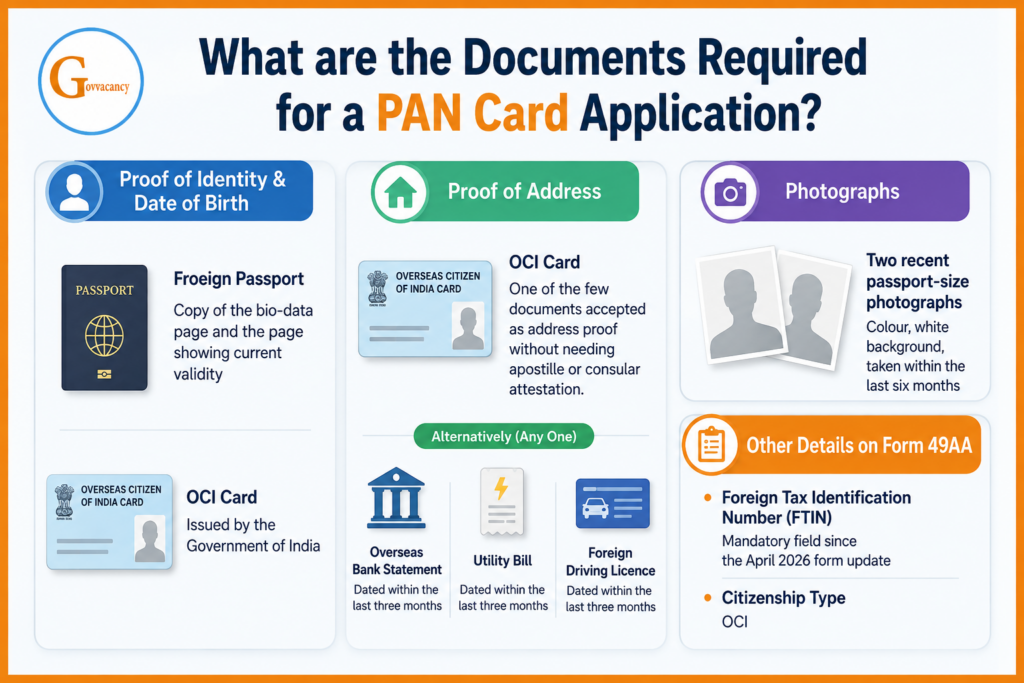
OCI applicants actually have a lighter documentation burden than most other foreign nationals, because the OCI card itself doubles as a valid document in more than one category.
Proof of Identity & Date of Birth
- Foreign passport (copy of the bio-data page and the page showing current validity)
- OCI card issued by the Government of India
Proof of Address
- OCI card (this is one of the few documents accepted as address proof without needing apostille or consular attestation, since it’s a Government-of-India-issued document)
- Alternatively: overseas bank statement, utility bill, or foreign driving licence, each dated within the last three months
Photographs
- Two recent passport-size photographs (colour, white background, taken within the last six months)
Other details asked on Form 49AA
- Foreign Tax Identification Number (now a mandatory field since the April 2026 form update)
- Citizenship type (OCI)
A useful rule of thumb: because you’re a foreign passport holder, most third-party documents (like a foreign driving licence used as address proof) would normally need apostille or Indian consular attestation. The OCI card is an exception — since it’s issued directly by the Indian government, it’s accepted as-is, which is why most OCI applicants find it simpler to rely on the OCI card wherever possible instead of hunting down attested alternatives.
What is the PAN Card Validity for OCI Cardholders?
A PAN card, once allotted, is valid for the applicant’s lifetime. It doesn’t need renewal, and it doesn’t expire if you change your address, your country of residence, or even your OCI card. If your OCI card is reissued (for instance, after a passport renewal), your existing PAN number stays the same — you would only need to file a correction request to update your records with the new document details, not apply for a fresh PAN.
One point some OCI holders ask about: PAN–Aadhaar linking. Since OCI cardholders are not eligible for Aadhaar as foreign citizens, this requirement does not apply to them — their existing PAN remains fully valid without it.
Common Mistakes to Avoid When Applying for a PAN
- Using the wrong form. The single most common error is an OCI holder filling out the citizenship-based form (Form 49A / Form 93) instead of Form 49AA (or updated Form 95 for foreign individuals). Your foreign passport nationality — not your Indian origin — determines the form
- Submitting an unattested document that needed attestation. Anything other than the OCI card, when used as address proof, generally needs apostille or Indian consular attestation. Skipping this step is a frequent cause of rejection.
- Mismatched names across documents. If your name appears differently on your passport, OCI card, and address proof (middle name order, initials, etc.), it can trigger a rejection or a request for clarification.
- Missing the 15-day physical dispatch window. If you choose the physical submission route instead of e-Sign, documents must reach the Pune processing centre within 15 days of the online application — missing this resets the process.
- Leaving the Tax Identification Number field blank. This has been a mandatory field on Form 49AA since the April 2026 update; incomplete fields are a common reason for processing delays.
- Assuming PAN needs renewal. Since PAN never expires, there’s no need to “renew” it — don’t file a fresh application when a correction request is all that’s needed.
- Ignoring the acknowledgment number. Without it, you can’t track your application status or follow up if something goes wrong.
Quick Tips for OCI Cardholders Applying for PAN
- Use the correct application form based on your foreign citizenship.
- Make sure your name and date of birth match your passport and OCI card.
- Keep your passport, OCI card, and address proof ready before starting the application.
- Double-check your foreign Tax Identification Number before submitting the form.
- Save your PAN acknowledgment number to track the application status.
- Apply only through official PAN application channels to avoid unnecessary delays.
Conclusion
OCI cardholders are not just eligible for a PAN card — for most, it’s a practical necessity for anything involving Indian banking, investment, or property. The process is straightforward once you know the two things that actually matter: use Form 49AA (or Form 95 for non-Indian citizens), and lean on your OCI card wherever you can, since it’s accepted as both identity and address proof without the attestation hassle that applies to other foreign documents.
FAQs
Can an OCI cardholder apply for a PAN card in India?
Yes. OCI cardholders are eligible to apply, but must use Form 49AA (formerly Form 49AA), the form for individuals who are not Indian citizens.
Is Form 49AA still valid, or should I use Form 49AA?
Form 49AA was replaced by Form 49AA for all new applications from April 1, 2026. Applications submitted under the old form before that date continue to be processed normally.
Does an OCI card need to be apostilled to be used for a PAN application?
No. The OCI card is a Government-of-India document, so it’s accepted as identity and address proof without apostille or consular attestation — unlike most other foreign-issued documents.
Is Aadhaar required for OCI cardholders to get a PAN card?
No. OCI cardholders are not eligible for Aadhaar, and it is not required for PAN application or linking.
How long does it take to get a PAN card as an OCI holder?
PAN allotment usually takes 10–15 working days. The e-PAN arrives by email shortly after, while a physical card mailed to an overseas address can take a few additional weeks.
Does a PAN card expire?
No. A PAN card is valid for life and does not need to be renewed.
