

Every year, thousands of passport applications are submitted, in which 100+ applications are rejected because the photo does not meet the official requirements. That completely delays your application.
The passport photo requirements vary from country to country. This means if a photo meets the standards for a U.S. passport may be rejected for a Canadian application.
Each country has its own Photo requirement. In this guide, Govvacancy will explain the official passport photo requirements, correct dimensions, background color, clothing guidelines, digital photo specifications, and the most common mistakes to avoid—helping you submit a compliant passport photo the first time and reduce the risk of delays or rejection for 2026 for the United States, India, the United Kingdom, Canada, and Australia.
Quick Comparison Table
| Country | Photo Size | Background | Head Height | Recency Rule |
| USA | 2 × 2 in (51 × 51 mm) | Plain white/off-white | 25–35 mm (1–1⅜ in) | Within 6 months |
| India | 35 × 45 mm | Plain white | 36–38 mm | Within 6 months |
| UK | 35 × 45 mm | Light grey or cream | 29–34 mm | Within 1 month |
| Canada | 50 × 70 mm | Plain white/light | 31–36 mm | Within 6 months |
| Australia | 35 × 45 mm (35–40 × 45–50 mm range) | Plain white/light | 32–36 mm | Within 6 months |
Notice how none of these five countries use identical specs, even though several look similar at a glance. Getting the millimeters and background tone right matters as much as taking a clear photo.
United States Passport Photo Requirements
Offline Size
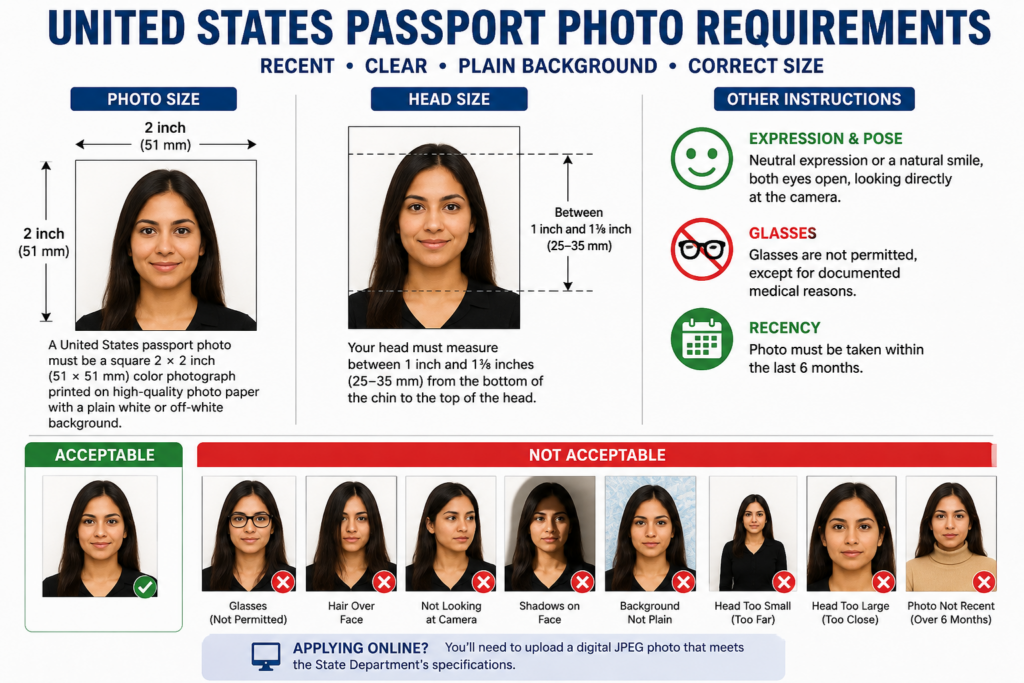
A United States passport photo must be a square 2 × 2 inch (51 × 51 mm) color photograph printed on high-quality photo paper with a plain white or off-white background. If you’re applying online, you’ll need to upload a digital JPEG photo that meets the State Department’s specifications.
Some of the other instructions you should follow-
- Your head must measure between 1 inch and 1⅜ inches (25–35 mm).
- Neutral expression or a natural smile, both eyes open, looking directly at the camera.
- Glasses are not permitted, except for documented medical reasons.
- Last 6 month Updated.
Online Size
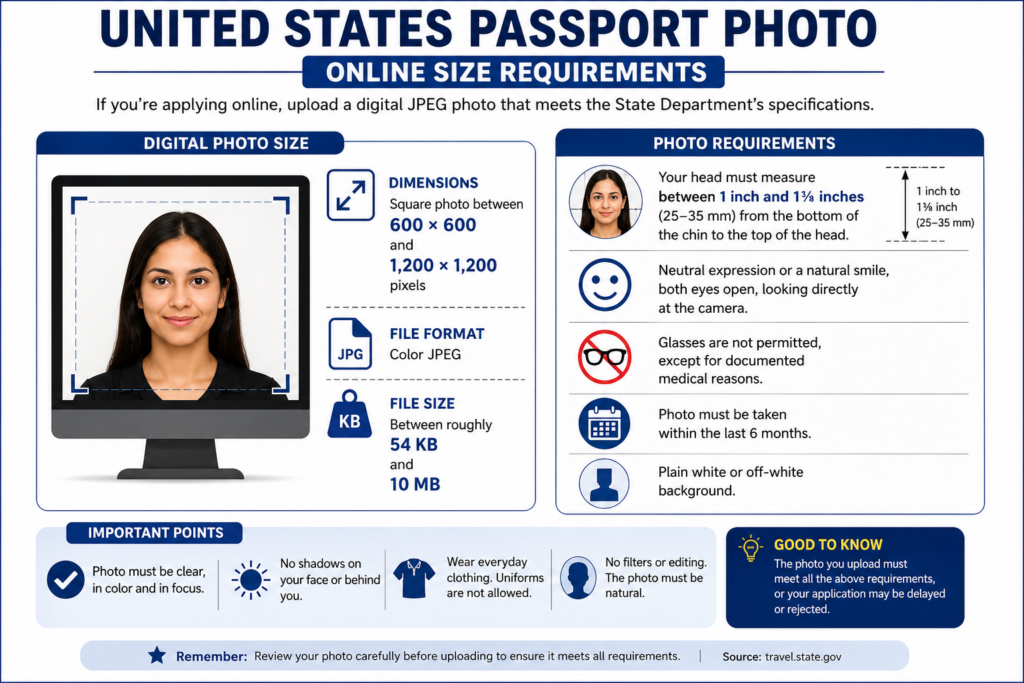
If you’re applying online, you’ll need to upload a digital JPEG photo you’ll upload a square color JPEG between 600 × 600 and 1,200 × 1,200 pixels, with a file size between roughly 54 KB and 10 MB that meets the State Department’s specifications.
Check the image below to know the size quickly.
Official source of this information: travel.state.gov – Passport Photos
India Passport Photo Requirements
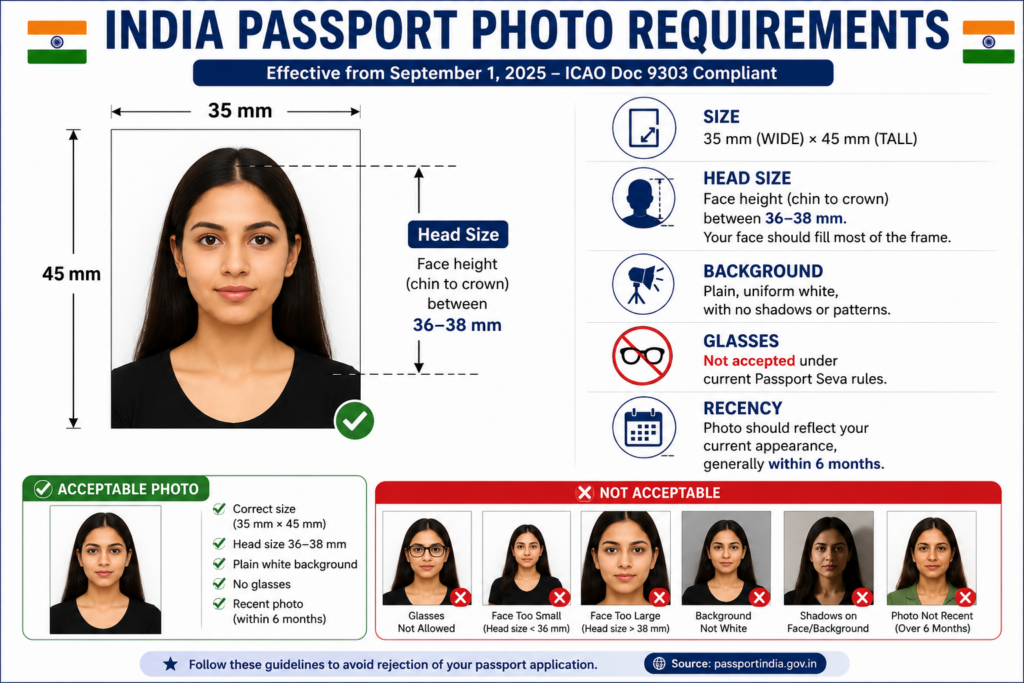
From September 1, 2025, India adopted ICAO Doc 9303-compliant passport photograph standards. As a result, the older 2 × 2 inch square photo has been replaced by the 35 × 45 mm rectangular format for applications that require a photograph.
- Size: 35 mm wide × 45 mm tall.
- Head size: Face height (chin to crown) between 36–38 mm — notably larger than most other countries, so your face should fill most of the frame.
- Background: Plain, uniform white, with no shadows or patterns.
- Glasses: Not accepted under current Passport Seva rules.
- Recency: Photo should reflect your current appearance, generally within 6 months.
Important note: The fresh and reissue application for adult photograph is captured digitally at the Passport Seva Kendra (PSK) itself, so no upload is needed. A printed 35 × 45 mm photo is still required for minors, certain annexures, Police Clearance Certificates, and some visa or OCI applications.
If applying through the Passport Seva portal or via a mission abroad, the digital upload is typically a JPEG file under the portal’s specified size limit..
Official source: passportindia.gov.in
United Kingdom Passport Photo Requirements
His Majesty’s Passport Office (HMPO) sets one of the stricter and more distinctive specifications, particularly around background color and recency.
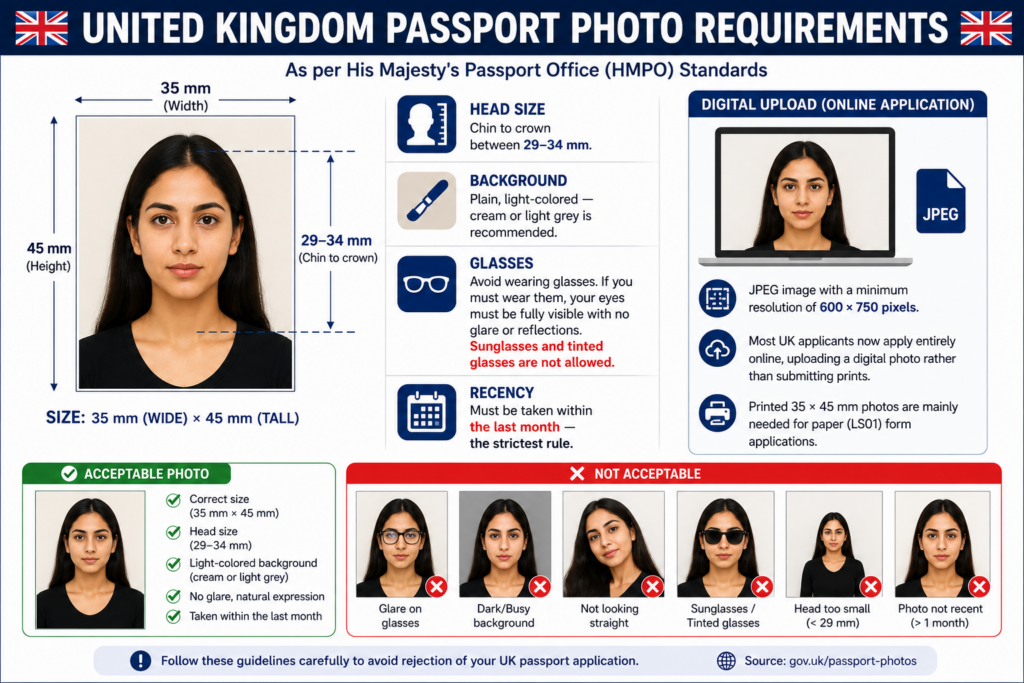
- Size: 35 mm wide × 45 mm tall.
- Head size: Chin to crown between 29–34 mm.
- Background: Plain, light-colored — cream or light grey is recommended. This is a key difference from the US and Australian standards, which call for white.
- Glasses: Avoid wearing glasses. If you must wear them, your eyes must be fully visible with no glare or reflections. Sunglasses and tinted glasses are not allowed.
- Recency: Must be taken within the last month — the strictest recency rule among these five countries.
- Digital uploads: For the online application system, JPEG image with a minimum resolution of 600 × 750 pixels.
Most UK applicants now apply entirely online, uploading a digital photo rather than submitting prints — printed 35 × 45 mm photos are mainly needed for paper (LS01) form applications.
Official source: gov.uk – Get a passport photo
Canada Passport Photo Requirements
Canada uses a size that doesn’t match any of the other four countries on this list, which makes it a common source of rejected applications for first-time or returning travelers.
- Size: 50 mm wide × 70 mm tall — notably taller than the UK, Indian, or Australian format, and different from the US square format.
- Head size: Chin to crown between 31–36 mm.
- Background: Plain white or light-colored, with even lighting and no shadows.
- Glasses: Not permitted since 2022.
- Guarantor requirement: For applications that require a guarantor, submit two identical printed photos. The back of one photo must include the photographer’s details, and the guarantor must complete the required certification and signature. Adult passport renewals generally do not require a guarantor
- Recency: Within the last 6 months.
Note for other Canadian documents: Work permits, study permits, visitor visas, and PR applications use the international 35 × 45 mm size instead of the 50 × 70 mm passport format — don’t mix these up.
Official source: Government of Canada – Passport photos
Australia Passport Photo Requirements
The Australian Passport Office (APO), part of the Department of Foreign Affairs and Trade (DFAT), publishes a size range rather than one fixed dimension, along with one of the more demanding endorsement processes.
- Size: 35–40 mm wide × 45–50 mm tall (35 × 45 mm is the most commonly cited standard figure).
- Head size: Chin to crown between 32–36 mm.
- Background: Plain white or light-colored, evenly lit with no shadows.
- Glasses: Discouraged and frequently rejected in practice, even without tint.
- Retouching: Explicitly prohibited — DFAT states photos must be unedited, down to skin blemishes and marks.
- Guarantor requirement: One of your two required printed photos must be endorsed on the back by an Australian citizen aged 18+ who has known you for at least 12 months and isn’t a close relative at the same address.
- Recency: Within the last 6 months.
Official source: Australian Passport Office – Photo guidelines
Common Reasons Passport Photos Get Rejected
Across all five countries, the same handful of mistakes account for most rejections:
- Wrong dimensions — using a US 2×2 photo for a Canadian or Indian application, or vice versa.
- Incorrect background color — using pure white for the UK (which prefers cream/grey) or a tinted background where white is required.
- Head size out of range — too much space above the head or below the chin, or a face that’s too small in the frame.
- Glasses worn — nearly every country listed here has phased out glasses in passport photos.
- Outdated photo — especially in the UK, where the recency window is only one month.
- Digital file issues — wrong file format, resolution, or file size for online upload systems.
Tips for Getting a Compliant Photo the First Time
- Use even, diffused lighting facing the subject directly to avoid shadows on the face or background.
- Stand at least 3 feet from the background to prevent shadows from falling behind you.
- Keep a neutral expression, mouth closed, both eyes open and visible.
- Remove glasses, hats, and head coverings (except for documented religious or medical reasons, which usually still require the full face to be visible from forehead to chin).
- Check the country-specific background color before you shoot — white is not universal.
- Measure head height carefully using the official diagram for your destination country rather than eyeballing it.
- Use the official government photo tool or checker where available, since these are free and reflect the current rules more reliably than third-party guides.
Frequently Asked Questions
Can I use the same photo for a US and UK passport application?
No. The dimensions (2×2 in vs. 35×45 mm) and background color expectations (white vs. cream/grey) differ, so a photo compliant with one will likely fail the other.
Do all these countries allow smartphone selfies for passport photos?
It depends. The US and UK generally accept a well-composed photo taken by another person or a compliant app, as long as it meets the technical spec. Canada and Australia, however, require the photo to be taken (and in Canada’s case, endorsed) by an approved party for the physical print, even though this can vary by application channel.
Why do some countries ban glasses now?
Most of these five countries have removed glasses from acceptable passport photos in the past several years because reflections and frames can interfere with the facial recognition matching used at border control.
How recent does my passport photo need to be?
This varies more than people expect — the UK requires a photo taken within the last month, while the US, India, Canada, and Australia generally require one within the last 6 months.
Where can I check the very latest requirements?
Always confirm with the official source before applying, since photo rules are updated periodically:
- USA: travel.state.gov
- India: passportindia.gov.in
- UK: gov.uk
- Canada: canada.ca
- Australia: passports.gov.au
Conclusion
No two of these five countries use an identical passport photo specification, and several updated their rules within the last year. The safest approach is to treat every application as its own project: confirm the exact size, background color, and digital requirements for the specific country and document type you’re applying for, rather than assuming a photo that worked once will work everywhere. A few extra minutes checking the official government page before you submit can save weeks of processing delay.
This guide reflects publicly available government guidance current as of 2026. Passport photo rules can change; always verify against the official source listed above before submitting your application.
